America's Black Sea Fleet by Robert Shenk
Author:Robert Shenk [Shenk, Robert]
Language: eng
Format: epub, mobi
ISBN: 9781612513027
Publisher: Naval Institute Press
Until late 1922, Bristol typically had only a small number of these versatile ships—typically only four, six, or eight at a time, although for a few months in 1920, he had twelve.19 However, the Navy continually rotated the destroyers to and from the States so that over the four years that the Navy operated from the Bosporus, at least forty destroyers saw significant duty there.20
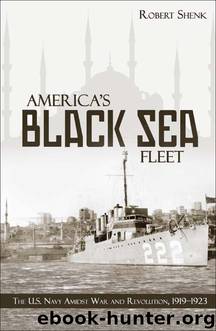
Destroyers of the day varied slightly in construction, but they all burned oil and most had four boilers and four stacks—hence the prime nickname given to this destroyer type ever since, “four pipers” or “four stackers,” though they were also known as “flushdeckers” for their distinctive flush weather decks. These “DDs” were driven by two shafts and two screws, had a normal displacement of about 1,200 tons, measured some 314 feet in length with a 31-foot beam (such a proportion being very narrow or “fine” even for typically long, narrow destroyers), and had a maximum draft of 12 feet. The fastest were rated to steam 35 knots at full horsepower, but 14 knots was their typical cruising speed, at which speed (assuming the propulsion equipment was in good condition and the bottom was clean), a full tank of oil could carry a vessel and its crew somewhere between 4,300 and 5,000 miles, depending on the specific destroyer class.21 Ship manning varied somewhat, but when Whipple joined Bristol’s navy in 1920, it had eight officers aboard (including one medical officer), along with twelve chiefs and some one hundred and ten enlisted men.22
Externally, the four pipers all had one main mast located just aft of the ship’s flying bridge, which was equipped with lines for signal flags, and on most four pipers this mast also supported an elevated lookout mount or crow’s nest. An enclosed bridge lay below the flying bridge. A second mast located aft also often carried some flag apparatus and usually another lookout mount. Each destroyer carried a couple of boats amidships and two anchors far forward, housed on either side of the bow. The small single rudder that each four-piper featured made for occasional low-speed maneuvering difficulties.
As for armament, these combatants featured four 4-inch/50 guns (one forward, one aft, and two amidships—one gun each to port and starboard on the top of the galley deckhouse). Each ship also had a 3-inch antiaircraft gun on the fantail and several machine guns. However, their “big punch” was composed of the twelve 21-inch torpedoes that they carried in four triple mounts at the ship’s beam, two of these mounts situated on the starboard side, and two on the port.
On the 1919–23 Near Eastern assignment, none of this considerable weaponry seems to have been fired in anger, but no doubt it deterred several attacks.
The destroyers that were assigned serially to Bristol were among the 270 destroyers or so that America had built between 1917 and 1921. Although the submarine threat of World War I had been the occasion of their construction, most of these vessels were completed too late actually to get into that war.
Download
This site does not store any files on its server. We only index and link to content provided by other sites. Please contact the content providers to delete copyright contents if any and email us, we'll remove relevant links or contents immediately.
| Africa | Americas |
| Arctic & Antarctica | Asia |
| Australia & Oceania | Europe |
| Middle East | Russia |
| United States | World |
| Ancient Civilizations | Military |
| Historical Study & Educational Resources |
The Radium Girls by Kate Moore(12097)
100 Deadly Skills by Clint Emerson(4975)
Rise and Kill First by Ronen Bergman(4842)
The Templars by Dan Jones(4740)
The Doomsday Machine by Daniel Ellsberg(4557)
The Rape of Nanking by Iris Chang(4267)
Killing England by Bill O'Reilly(4045)
Stalin by Stephen Kotkin(4010)
Hitler in Los Angeles by Steven J. Ross(3982)
12 Strong by Doug Stanton(3583)
Hitler's Monsters by Eric Kurlander(3389)
The Code Book by Simon Singh(3254)
Blood and Sand by Alex Von Tunzelmann(3243)
Darkest Hour by Anthony McCarten(3164)
The Art of War Visualized by Jessica Hagy(3047)
Hitler's Flying Saucers: A Guide to German Flying Discs of the Second World War by Stevens Henry(2778)
Babylon's Ark by Lawrence Anthony(2722)
Tobruk by Peter Fitzsimons(2565)
The Second World Wars by Victor Davis Hanson(2555)
